Disclosure: This article contains affiliate links to Cannabuben.
Notice: The information in this article is for informational purposes only and does not constitute medical advice.
Fibromyalgia and CBD: An Emerging Area of Research
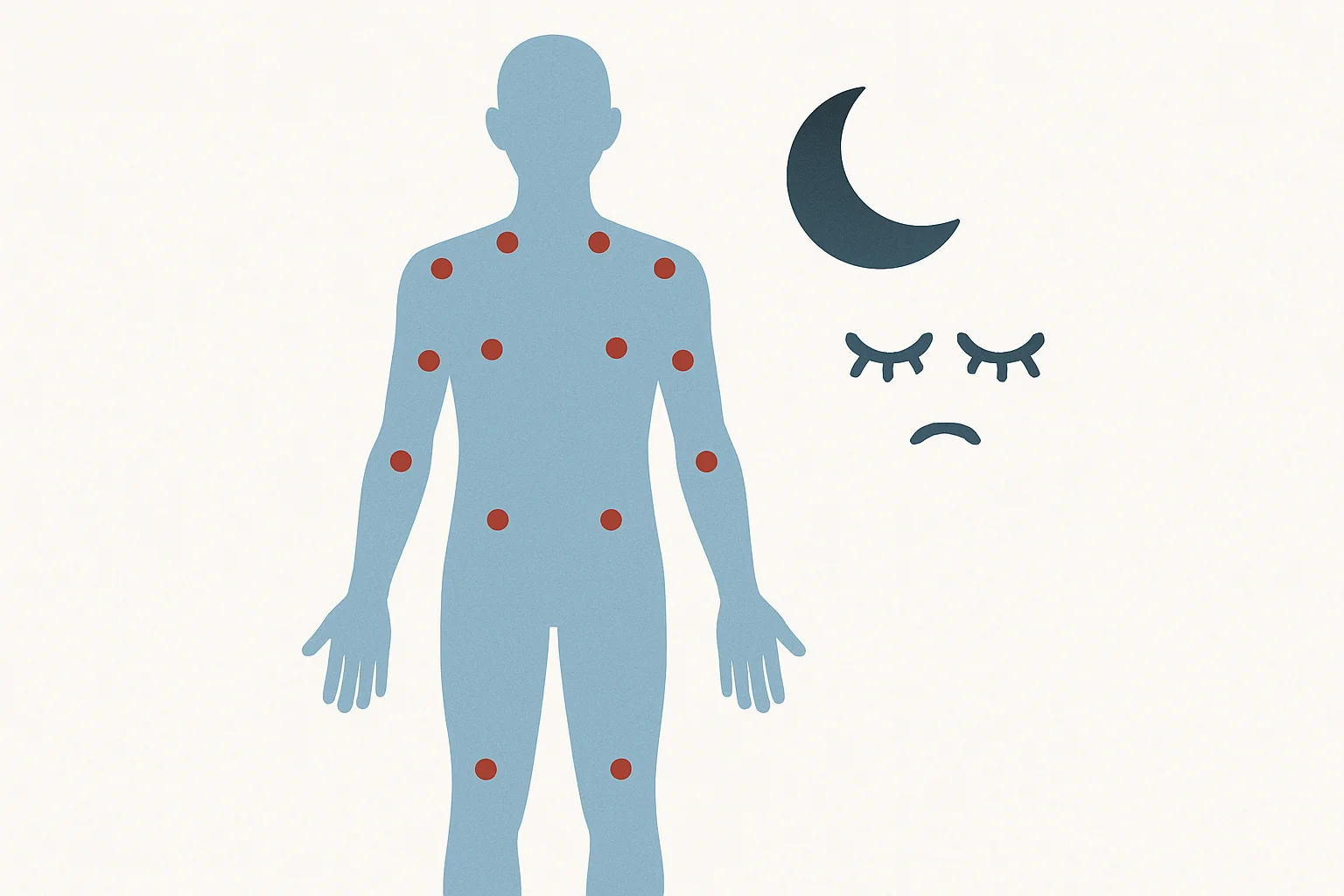
Fibromyalgia affects an estimated 1.5 to 2 million people in the United Kingdom. Characterised by widespread chronic pain, fatigue, cognitive difficulties ("fibro fog") and sleep disturbances, it remains one of the most challenging conditions to treat effectively. Standard treatments — pregabalin, duloxetine, amitriptyline — provide relief for some but leave many patients searching for alternatives.
CBD has attracted considerable interest among fibromyalgia sufferers. But what does the actual science say? This article examines the clinical evidence, the theoretical mechanisms and the practical considerations for anyone in the UK thinking about CBD for fibromyalgia.
Understanding Fibromyalgia
Before looking at CBD, it helps to understand what fibromyalgia actually is:
Core Symptoms
- Widespread pain: affecting multiple body areas, often described as a constant dull ache lasting at least three months
- Fatigue: persistent tiredness that is not relieved by sleep
- Cognitive difficulties: problems with concentration, memory and mental clarity
- Sleep disturbances: unrefreshing sleep, difficulty falling or staying asleep
- Additional symptoms: headaches, irritable bowel syndrome, mood disturbances, sensitivity to temperature
Current Understanding
Fibromyalgia is believed to involve central sensitisation — the central nervous system amplifies pain signals, making the brain and spinal cord process pain abnormally. This is why standard painkillers often provide limited relief.
The exact cause remains unknown, though it may involve genetic factors, physical or emotional trauma, infections and abnormalities in pain-processing pathways.
The Endocannabinoid System and Fibromyalgia

Clinical Endocannabinoid Deficiency Theory
Dr Ethan Russo proposed the clinical endocannabinoid deficiency (CED) theory in 2004, suggesting that conditions like fibromyalgia, migraine and irritable bowel syndrome may share a common cause: an underactive endocannabinoid system [Russo, 2004].
The theory proposes that insufficient endocannabinoid levels or function could explain why these conditions:
- Involve similar symptom profiles (pain, fatigue, mood disturbances)
- Frequently co-occur
- Respond poorly to conventional treatments
- May respond to cannabinoid therapy
While the CED theory remains a hypothesis, it provides a logical framework for understanding why cannabinoids might help with fibromyalgia.
How CBD May Address Pain Signalling
CBD interacts with multiple receptor systems relevant to fibromyalgia:
- TRPV1 receptors: involved in pain perception and inflammation — CBD acts as an agonist, potentially desensitising these pain receptors
- 5-HT1A receptors: serotonin receptors involved in mood and pain modulation
- FAAH inhibition: CBD inhibits the enzyme that breaks down anandamide, potentially raising levels of this endogenous pain-modulating compound
- Adenosine receptors: CBD may enhance adenosine signalling, which has anti-inflammatory and analgesic properties
- Glycine receptors: involved in pain processing in the spinal cord
What the Scientific Studies Say
Habib & Artul (2018) — Clinical Improvement
This observational study examined fibromyalgia patients using medical cannabis in Israel:
- Patients reported significant reductions in pain intensity
- Improvements in sleep quality and fatigue
- Reduced use of other medications in many cases
- The study noted that cannabis appeared to be a valid treatment option for fibromyalgia [Habib & Artul, 2018]
Limitation: this was not a randomised controlled trial, and participants used whole-plant cannabis (not CBD alone).
Van de Donk et al. (2019) — Evoked Pain Study
This Dutch study used a more rigorous methodology (randomised, placebo-controlled, crossover):
- Fibromyalgia patients inhaled four different cannabis varieties, including a CBD-dominant strain
- The CBD-dominant variety reduced spontaneous pain scores
- THC-dominant varieties were more effective for pressure pain
- The study highlighted different cannabinoid profiles for different pain types [Van de Donk et al., 2019]
Sagy et al. (2019) — Six-Month Observation
This Israeli study followed fibromyalgia patients using medical cannabis over six months:
- 81.1% reported moderate to significant improvement in their condition
- Pain intensity decreased from a median of 9 to 5 on a 0-10 scale
- Sleep improved in 73.4% of participants
- 35.2% reduced or stopped other pain medications
- Side effects were generally mild [Sagy et al., 2019]
Walitt et al. (2016) — Cochrane Review
The Cochrane Collaboration reviewed the evidence for cannabinoids and fibromyalgia:
- Concluded there was insufficient evidence to recommend or discourage cannabinoid use
- Noted that available studies were small, short-term and methodologically limited
- Called for large-scale, well-designed trials [Walitt et al., 2016]
The Evidence Gap
The honest assessment is that evidence for CBD specifically (as opposed to whole-plant cannabis or THC) for fibromyalgia remains limited:
- Most studies used whole-plant cannabis, not isolated CBD
- Sample sizes are small (typically under 100 participants)
- Long-term data is scarce
- No study has definitively established CBD as an effective fibromyalgia treatment
The NHS Perspective
The NHS does not currently recommend CBD for fibromyalgia. Standard NHS treatments include:
- Medications: pregabalin, duloxetine, amitriptyline
- Exercise: aerobic exercise and strength training
- Cognitive behavioural therapy (CBT)
- Self-management programmes
Medical cannabis (including CBD-dominant preparations) can be prescribed privately through specialist clinics, but this is not available through standard GP pathways and can be costly.
CBD Dosage for Fibromyalgia
Recommended Approach
Given the chronic nature of fibromyalgia, a gradual and consistent approach is essential:
- Starting dose: 10-25 mg of CBD per day
- Increase: by 5-10 mg every 5-7 days
- Common maintenance dose: 25-75 mg per day
- Higher doses in studies: up to 150-300 mg (clinical settings)
- Assessment period: allow at least 4-6 weeks for evaluation
Sublingual vs Topical
For fibromyalgia, a combination approach may be most useful:
| Application | Format | Best For |
|---|---|---|
| Sublingual oil | Drops under the tongue | Widespread pain, fatigue, sleep, overall symptom management |
| Topical cream | Applied to specific areas | Localised pain points, tender areas, joint stiffness |
| Capsules | Swallowed with water | Consistent daily dosing, convenience |
Many fibromyalgia patients find that sublingual oil for general symptom management, combined with topical application to specific pain points, offers the most comprehensive approach.
Find the right CBD oil strength at Cannabuben →
Drug Interactions
This is particularly important for fibromyalgia patients, who often take multiple medications. CBD can interact with:
- Pregabalin: no known direct interaction, but monitor for increased sedation
- Duloxetine: metabolised by CYP2D6, which CBD may inhibit — consult your prescriber
- Amitriptyline: metabolised by CYP2D6 — consult your prescriber
- NSAIDs: generally considered safe to combine, but monitor for gastrointestinal effects
- Opioids: CBD may alter opioid metabolism — medical supervision essential
Always consult your GP or rheumatologist before adding CBD to your treatment regimen, particularly if you take prescription medications.
Living With Fibromyalgia: An Integrated Approach
CBD should not be viewed as a standalone treatment. The most effective fibromyalgia management typically involves multiple strategies:
- Prescribed medications as directed by your healthcare team
- Regular exercise: even gentle activities like swimming, walking or yoga can help
- Sleep hygiene: consistent sleep schedule, cool dark room, limited screens before bed
- Stress management: mindfulness, meditation, CBT
- Pacing: balancing activity with rest to avoid boom-and-bust cycles
- CBD as a potential complementary approach — not a replacement for the above
UK Legal Considerations
- CBD is legal to purchase and use in the UK without a prescription
- Products must contain no more than 1 mg THC per container
- CBD products should have a validated FSA Novel Food application
- No CBD product may legally claim to treat fibromyalgia or any medical condition
- Medical cannabis (prescription) is available through private clinics for certain conditions, including chronic pain
View lab-tested CBD oils at Cannabuben →
FAQ
Can CBD help with fibromyalgia?
Emerging research suggests CBD may help some people manage certain fibromyalgia symptoms, particularly pain and disturbed sleep. Studies such as Habib & Artul (2018) and Sagy et al. (2019) reported meaningful symptom improvements in their participants. However, the overall evidence is not yet strong or consistent enough to support official medical recommendations, and much of it comes from small or observational studies. CBD is therefore best viewed as a possible complementary approach to be used alongside conventional treatment, rather than a proven or standalone therapy for fibromyalgia. Because fibromyalgia is complex and individual, anyone considering CBD should do so in consultation with their GP or rheumatologist. This is not medical advice.
What dose of CBD for fibromyalgia?
A common approach is to start low, at around 10–25 mg of CBD per day, and increase gradually by roughly 5–10 mg every 5–7 days while monitoring how you respond. Reported maintenance doses often fall somewhere between 25 and 75 mg daily, but there is no universal figure, as individual sensitivity and the severity of symptoms vary. It is usually sensible to allow at least four to six weeks before judging whether CBD is helping, since effects on chronic conditions can build slowly. Some people combine sublingual oil for an overall effect with a topical cream for specific areas. Anyone on medication should seek medical advice first. This is not medical advice.
Is CBD better than pregabalin for fibromyalgia?
There is no direct head-to-head study comparing CBD with pregabalin for fibromyalgia, so it is not possible to say one is 'better' on the evidence. What can be said is that pregabalin has far stronger clinical evidence and is an established, approved treatment, whereas CBD's evidence base remains preliminary. CBD may have a role as a complementary approach for some people, but it should not be regarded as an equivalent replacement, and prescribed medication should never be stopped or reduced without medical supervision. If you are weighing up your options, the right course is to discuss them with your GP or rheumatologist, who can take your full situation into account. This is not medical advice.
Can I take CBD with fibromyalgia medications?
This needs medical input. CBD can interact with a number of medicines through the cytochrome P450 enzyme system, and that includes drugs commonly used in fibromyalgia such as duloxetine and amitriptyline, where altered drug levels could change effects or side effects. For this reason you should always consult your GP or rheumatologist before combining CBD with any prescription medication, so they can weigh up your full treatment picture. Just as importantly, you should never stop or reduce a prescribed medication on your own in order to use CBD, as doing so can be harmful. Used carelessly alongside medication, CBD can carry real risks, which professional guidance is there to manage. This is not medical advice.
Does the NHS recommend CBD for fibromyalgia?
No, the NHS does not currently recommend over-the-counter CBD for fibromyalgia. Standard NHS management typically includes options such as pregabalin, duloxetine, graded exercise and cognitive behavioural therapy (CBT), which have a stronger evidence base. Medical cannabis is a separate matter: it may in some cases be accessible through private specialist clinics for patients with an unmet clinical need, but this is distinct from the wellness CBD products sold in shops and online. Anyone living with fibromyalgia should work with their GP or specialist on an evidence-based plan, and can raise CBD with them rather than relying on it instead of recommended treatment. This is not medical advice.
Conclusion
The science of CBD and fibromyalgia is at an early but promising stage. The clinical endocannabinoid deficiency theory provides a plausible mechanism, and observational studies show encouraging results — but the evidence is not yet strong enough for definitive recommendations.
If you are considering CBD for fibromyalgia, discuss it with your healthcare team, start with a low dose, be consistent, and give it at least four to six weeks. View CBD as one component of a comprehensive management strategy, not a miracle cure. The most important step is working with your medical team to find the combination of treatments that works best for you.
The information contained in this article does not replace medical advice. If you have fibromyalgia, work with your GP or rheumatologist on your treatment plan.